
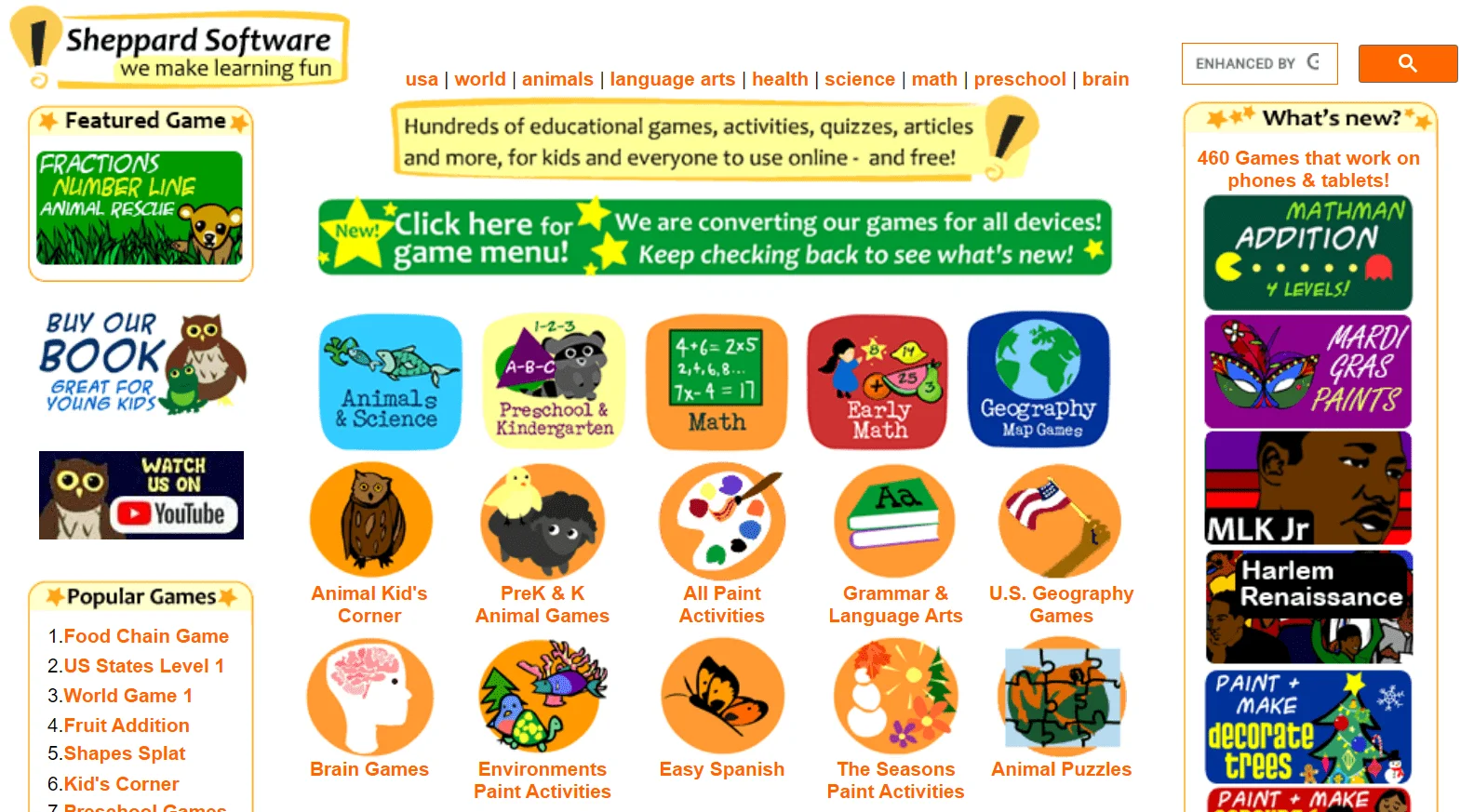
The first time a kid learns what a “producer” is, it usually doesn’t come from a textbook. It comes from a game, something bright, clickable, maybe a little chaotic. Suddenly, plants aren’t just green blobs in a diagram. They’re part of a system. A chain. A story.
That’s the quiet magic of Sheppard software.
What looks like a collection of simple browser games is actually a surprisingly effective biology lab, just one that trades microscopes for mouse clicks.
Biology, But Make It Playable
Let’s start with the obvious: most biology lessons can feel… dense. Terms like “omnivore,” “decomposer,” or “classification” don’t exactly scream fun.
But Sheppard software flips that script by turning these ideas into interactive challenges. Instead of memorizing definitions, players sort animals, build food chains, or match species to environments.
And it works.
The platform hosts hundreds of free educational games across subjects, including a deep library of animal and science activities designed for different age levels.
Short version? You’re not just reading biology, you’re doing it.
The Animal Games That Actually Teach Something
Not all “educational games” live up to the label. These do. Here’s where the biology learning really clicks:
1. Food Chain Games (a.k.a. Who Eats Whom?)
This is where things get interesting, and slightly ruthless.
Players build ecosystems by linking producers, consumers, and decomposers. It’s simple on the surface, but it introduces core ecological concepts like energy flow and interdependence.
Even better, it reinforces cause-and-effect thinking. Remove one species? The whole system shifts.
That’s not just a game, that’s ecology in action.
2. Animal Classification Games
Sorting animals into mammals, reptiles, amphibians, and more sounds basic… until you’re racing against time.
These games train pattern recognition and scientific categorization. Players learn to identify traits, fur, eggs, habitats, without realizing they’re practicing taxonomy.
And yes, it sticks.
Because instead of memorizing, you’re deciding.
3. Animal Diet & Behavior Games
Carnivore, herbivore, omnivore. Easy words, until you have to apply them.
In these games, players match animals to diets or behaviors, reinforcing real-world biology concepts like feeding relationships and survival strategies.
It’s quick, intuitive, and surprisingly effective.
4. Endangered Animals & Ecosystem Awareness
Here’s where things get a little more serious.
Some Sheppard software animal games introduce conservation topics, endangered species, environmental threats, and biodiversity.
It’s not heavy-handed. But it’s enough to spark curiosity.
And maybe a few questions afterward.
Why It Works (When Textbooks Don’t)
There’s a reason this format sticks.
Educational research consistently shows that interactive learning improves retention, especially in younger learners. The U.S. Department of Education on interactive learning highlights how engagement and feedback loops help students absorb complex topics more effectively.
That’s exactly what these games do:
- Immediate feedback (right or wrong, no waiting)
- Visual reinforcement (colors, movement, sound)
- Repetition without boredom
Instead of forcing focus, they invite it.
Not Just for Kids (Seriously)
Here’s the part people don’t expect.
While Sheppard software is built with kids in mind, it quietly scales up. There are multiple difficulty levels, and even older students, or adults, can use it to review concepts like food webs or classification systems.
Think of it as low-pressure learning. No grades. No stress.
Just curiosity.
A Gateway to Bigger Science Thinking
These games might start small, matching animals, building chains, but they lead somewhere bigger.
They introduce:
- Systems thinking (how organisms connect)
- Scientific classification
- Environmental awareness
In other words, the foundations of biology.
And if you’re curious how these concepts show up in real-world science, resources like National Geographic’s animal education hub expand on the same ideas with deeper context and real-life examples.
Final Thought: Learning That Doesn’t Feel Like Learning
Here’s the thing.
Kids don’t sit down thinking, “I’d love to study ecosystems today.” But they will click on a game. They will try to win. They will try again.
And somewhere between “try again” and “level complete,” biology sneaks in.
That’s the real strength of Sheppard software animal games, they don’t replace traditional learning. They soften it. Translate it. Make it approachable.
Not perfect. Not flashy. But effective.
And sometimes, that’s exactly what learning needs.
*This article is for informational purposes only and should not be taken as official legal advice*